
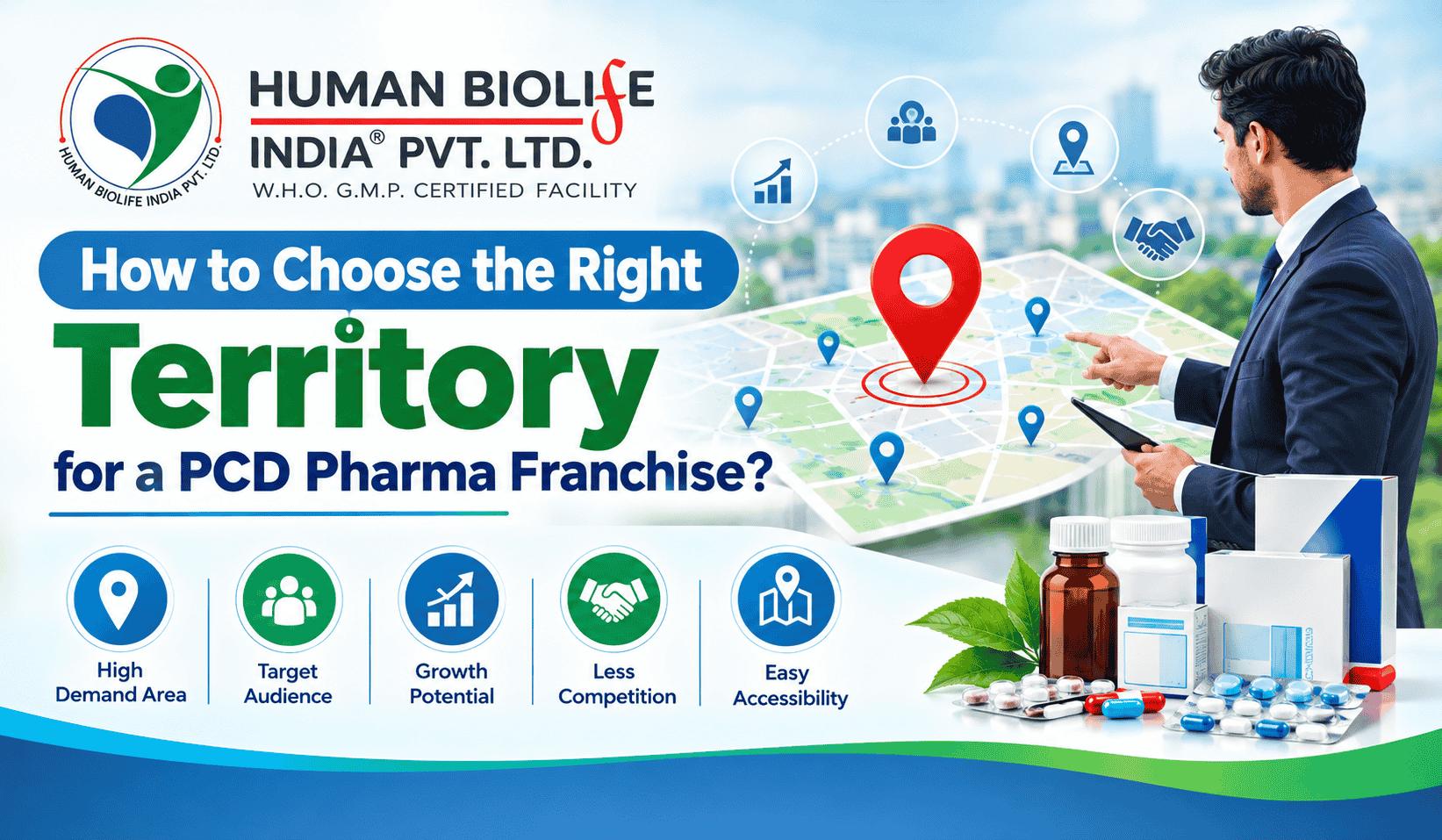
How to Choose the Right Territory for a PCD Pharma Franchise? India’s pharmaceutical sector keeps opening up chances for distributors, entrepreneurs, medical representatives, and investors who want to get into organized medicine distribution. The domestic pharmaceutical market in India was valued at about ₹5.30 lakh crore (US 130 billion) by 2030. The sector has shown growth over the years with a compound annual growth rate of 9.43% over the last nine years.
Recent market indicators further show that pharmaceutical demand remains healthy. The domestic pharmaceutical market was reported to grow by around 11.5% during April–June 2026, while India’s overall pharmaceutical sector is projected to record 10% growth in FY27. With this increasing demand, selecting the right territory has become an important factor for a successful PCD Pharma Franchise. A suitable territory can provide doctor coverage, retailer access, repeat orders, and long‑term business potential.
A strong territory can bring repeat orders, make it easy for prescribers to find the product, and help people remember the brand quickly. A weak territory can lead to stock that sits, products that expire, and frustration for everyone involved. When two franchisees sell the same product range and get the same company support, the results can be very different simply because of the territory’s location. I believe that territory selection should be treated like a business decision that relies on research, not a gut feeling.
A strong territory can bring repeat orders, easy prescriber access, and quick brand recall. A weak territory can cause stock, expiry losses, and frustration. Two franchisees who sell the product range and receive the same company support can experience completely different outcomes simply because of the territory location. Treat territory selection as a business decision that relies on research, not on gut feeling.
Your business relies on doctors and stores that sell medicine. Look at how many registered doctors, clinics, nursing homes, and hospitals are in the area. Also count the number of chemist shops and wholesalers. A good balance of doctors to patients shows a medical system. If there are not enough doctors, it can limit the number of prescriptions. If there are many doctors, it can be hard to get their attention.
Different regions have health profiles. Coastal and humid zones see fungal infections and respiratory illnesses. Urban areas report rates of diabetes, hypertension, and lifestyle disorders. Rural belts may see seasonal infections and nutritional deficiencies. Study health data and ask doctors about the therapies they prescribe most so you can pick a company whose portfolio matches those therapies.
Competition can be a sign of demand. Competition is not always bad. In a market crowded with multinational brands and entrenched local distributors, competition makes it hard for a new franchisee. Visit chemists, note which brands are stocked, and ask how many medical representatives visit each day. Look for gaps: therapeutic segments with quality brands present an opening.
People's spending capacity decides if they buy branded generics, premium products, or low-cost essentials. In towns, agricultural hubs, and cities with strong employment, people often have higher purchasing power. In lower-income areas, a range of products with good margins might perform better. Make sure your pricing strategy matches the economy.
Can you reach doctors and chemists easily? Look at road and rail connectivity, travel time between towns, and whether courier or transport services are available. Poor connectivity can lead to delivery delays, higher travel costs, and a greater chance of stock-outs. A smaller connected area often brings better profits than a large spread-out region.
You will do best when you already know the language, culture, and medical community. You already have contacts with doctors, chemists, or hospital staff, so you have an advantage that outsiders need years to develop. If you have no network, pick a region where you can spend time building relationships.
Check with the PCD company to confirm that the territory is really available and that you will receive written monopoly rights. Ask the PCD company whether the PCD company already has a distributor or direct sales team nearby because overlapping claims cause conflict. Get the area clearly defined in the agreement by district or PIN code to avoid disputes later.
Drug license requirements, GST rules, and paperwork can be a little different in each state. Make sure you can get a drug license for the place you pick and that the company's products are allowed to be sold in that state. Deal with rules and regulations early so they don't slow down your start.
Look ahead, not at today’s numbers. New hospitals, medical colleges, industrial corridors, highways, and housing projects all point to rising healthcare demand. A developing district today can become a high-revenue market in three to five years. Getting in early secures you a strong position.
1. What factors should be considered when selecting a territory?
Consider population, healthcare demand, competition, doctor availability, and the potential for long-term business growth.
2. How can I identify a profitable territory?
Analyze local demand, existing competitors, purchasing patterns, and the availability of healthcare facilities in the area.
3. Why is competition important when choosing a territory?
A highly competitive area may make market entry difficult, while a territory with balanced competition can offer better growth opportunities.
4. Should I choose an urban or rural territory?
The choice depends on healthcare demand, population density, purchasing capacity, and the availability of medical facilities in the region.
5. How does doctor availability affect territory selection?
A good network of doctors and healthcare professionals can support product awareness, demand generation, and consistent market development.
6. Is population size important for territory selection?
Yes, a larger and medically active population can provide a wider customer base and greater potential for business expansion.
We are engaged in manufacturing and supplying a wide range of formulations such as tablets, injections and new drugs that are DCGI Approved.
2026 © Human Biolife India PVT. LTD.